
🕹️ The PM OS for Cursor/Claude Code + PMF Plugin
+ New AI Skills
Hello!
This is 🕹 prodmgmt.world | Becoming Top PMs Together
🆕 In today’s edition:
🆓 The PM OS for Cursor/Claude Code Is Here!
🆓 PMF Plugin for Claude Code/Cursor
🔒 New AI Skills
The PM OS for Cursor/Claude Code Is Here!
I’ve been building out the v1 of my PM OS for Cursor/Claude Code over the past few weeks.
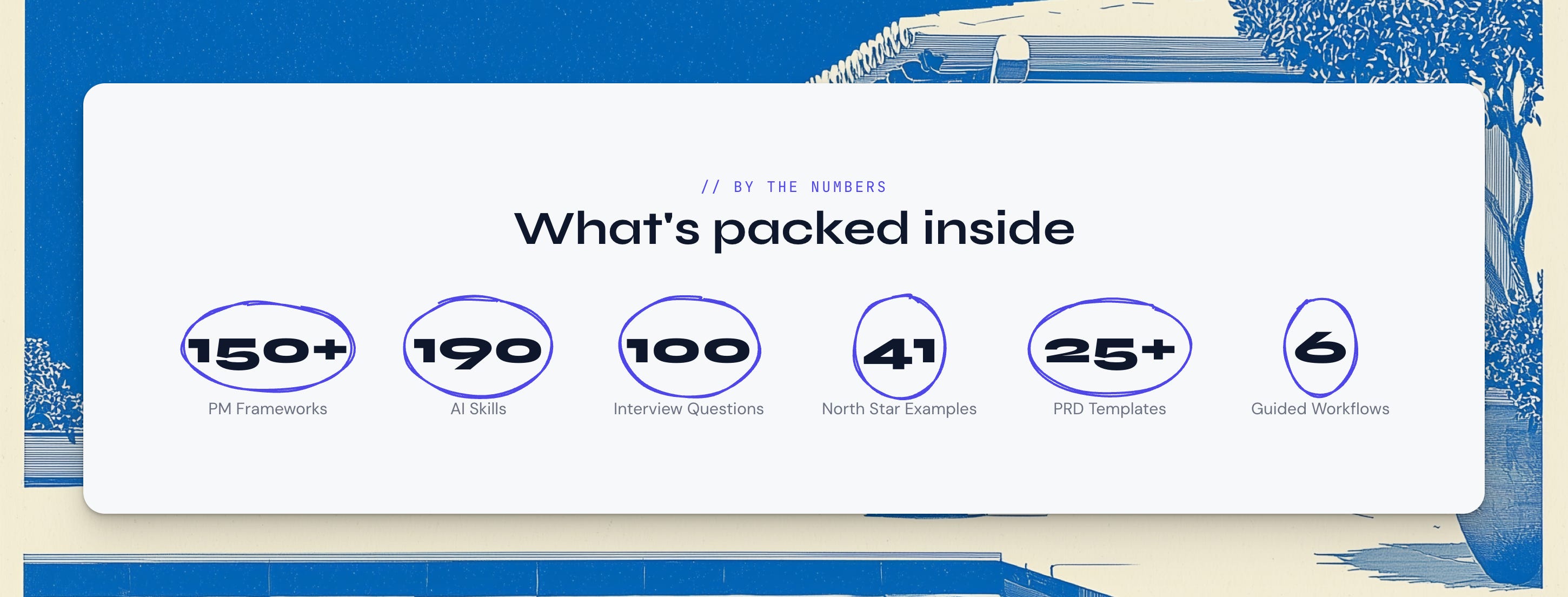
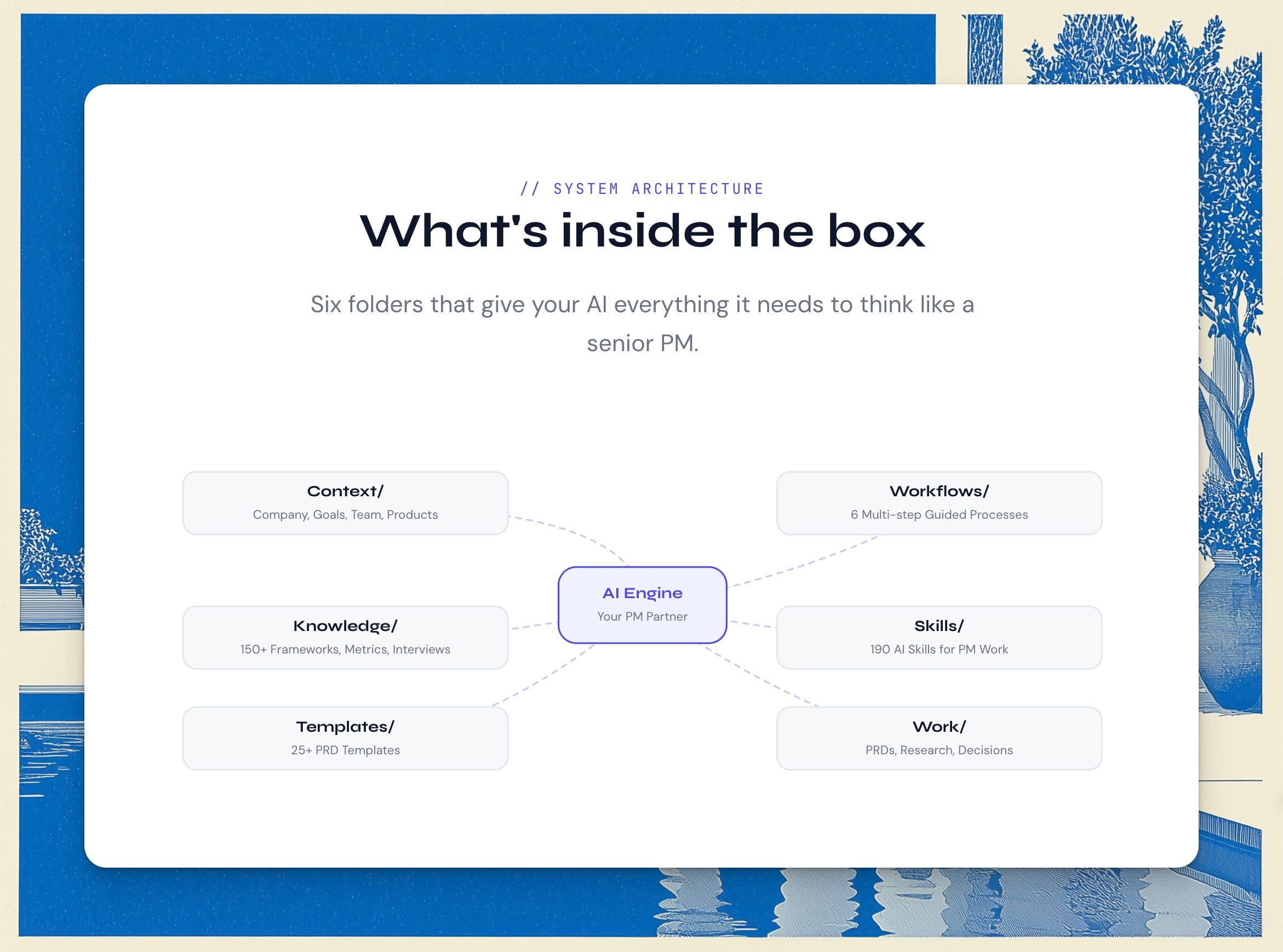
If you bought the original Complete PM System, you’ll be getting an email from Polar shortly with access details.
If you haven’t bought it yet, now’s a great time to buy — early bird pricing applies.
My ask is simple: use it and tell me your /feedback!
Before I cover today’s topic, I wanted to briefly cover off what it can help you do:
Once set up, it can help you move through PM tasks with record speed, without losing quality, and often raising the bar. It knows your context in and out, so after the initial onboarding, you can just kick into whatever work you need. You will need to have Cursor or Claude Code to make it work.
I’ve designed it so the system intelligently (with the help of the agentic harness + LLMs, of course) orchestrates a bunch of useful skills and workflows that activate contextually.
It’s not just PRD writing, of course. My AI skills collection has so much more, from design and ideation skills to many useful stakeholder management and communication skills I use daily. It will help you navigate office politics, convince people and ship great product, all from one interface.
If there’s relevant knowledge, including frameworks and articles that help you think better through your problem, it will also help you learn as you go, improving your own product practice. You also have a way to practice your craft using specially-designed PM drills that you can run, log and see improvements over time.
I also added my favorite external skills, which I have shared before in my Claude Code hub:
shaping skills by Ryan Singer for running Shape Up style workflows
front-end slides skill, which has been amazing for creating high-quality slide decks for communicating your work.
You can layer any other skills you like into this system, and it will only keep improving. I will also regularly ship updates as more skills and ideas arrive.
Why did I decide to build this?
Back in 2020, I made the original prodmgmt.world as the first collection of PM techniques and frameworks that classified them across the dimensions of risk and product process.
It helped people understand that many frameworks they found online were the wrong choice for their situation, while also showing them new techniques that were actually useful.
Now, AI has firmly entered our professional lives, so I realised that PMs need all of this knowledge integrated into their process and tools even more tightly.
But I didn’t want to build another ChatPRD. It would have been foolish to try to compete with a product that was already so heavily built out, anyway. Plus I felt like writing PRDs was only a small part of the PM job.
At the same time, I am convinced that tools like Cursor and Claude Code are becoming so ubiquitous, and local files, CLIs & MCPs are enabling so much new untapped value right on our machines, that trying to push people into yet another web tool was a fool’s errand. Asking to install a Slack bot or Chrome extension would have under-delivered on the value, as well.
Meanwhile, I am in Cursor and Claude Code daily, at work and at home, so this felt like the right move. It’s a tradeoff - I’m borrowing a lot from those tools - but the point of product management is to ship value to as many people as possible in the leanest way you can.
It’s a gamble, I don’t know if it will work for others, but I know it works for me. I hope it’ll make your work life easier. Enjoy.
Hit /feedback if something’s not working, or /testimonial if you really like it.
Now on to today’s topic.
PMF Plugin for Claude Code/Cursor
If you have an idea, you’re a founder now
A lot has changed in the last year or so. I’ve been noticing it in myself and in the people I talk to.
The bottleneck used to be: I have an idea but I don’t know how to build it. You needed a co-founder who could code, a designer, a budget, probably a few months of runway just to see if it worked. That friction stopped most ideas before they started.
Claude Code, Cursor, vibe coding: you can go from idea to working prototype in a weekend.
The question changed
But the failure mode didn’t go away. Teams still build things nobody wants. Founders still spend six months on a product that turns out to solve a problem that isn’t acute enough, for a customer they don’t really understand, through a channel they never validated. The wreckage just arrives faster now.
The constraint went from “can you build it?” to “should you build it?” And most people have no process for answering that second question before they start.
I’ve been working through a framework for this, packaged as a set of Claude Code/Cursor skills over the past few months. The approach is a structured hypothesis builder across six dimensions, validated through analogs and antilogs before you write a single line of code.
I want to walk you through how it works, because I think it applies to anyone with an idea right now, not just product managers.
The framework: six dimensions, not one
Most people treat PMF as something you either have or don’t, something that shows up (or doesn’t) in retention curves once you have a product. That framing is fine as a diagnosis, but it doesn’t help you before you’ve built anything.
The framework breaks PMF into six dimensions, each of which can be written out, scored, and validated independently:
Problem to solve: What’s the outcome the customer is trying to reach? What’s preventing them from getting there? What’s the pain of not solving it?
Target audience: Who is the “now segment”? Not everyone who might eventually use this. The narrow group for whom the problem is most acute right now.
Value proposition: The benefits your solution delivers and why those benefits matter to this audience.
Competitive advantage: What makes this defensible over time? This is where most founders are weakest.
Growth strategy: How do you reach the first 50-100 users? And what’s the scalable channel after that?
Business model: What’s the equation? Revenue × retention × CAC. Where does the math break?
What the six dimensions do well is surface very different things. You can have a clear, articulate problem and a fuzzy, untested audience. You can have a sharp value proposition and zero credible path to competitive advantage. The framework forces you to look at each one honestly, separately.
The first step: build a V1 narrative
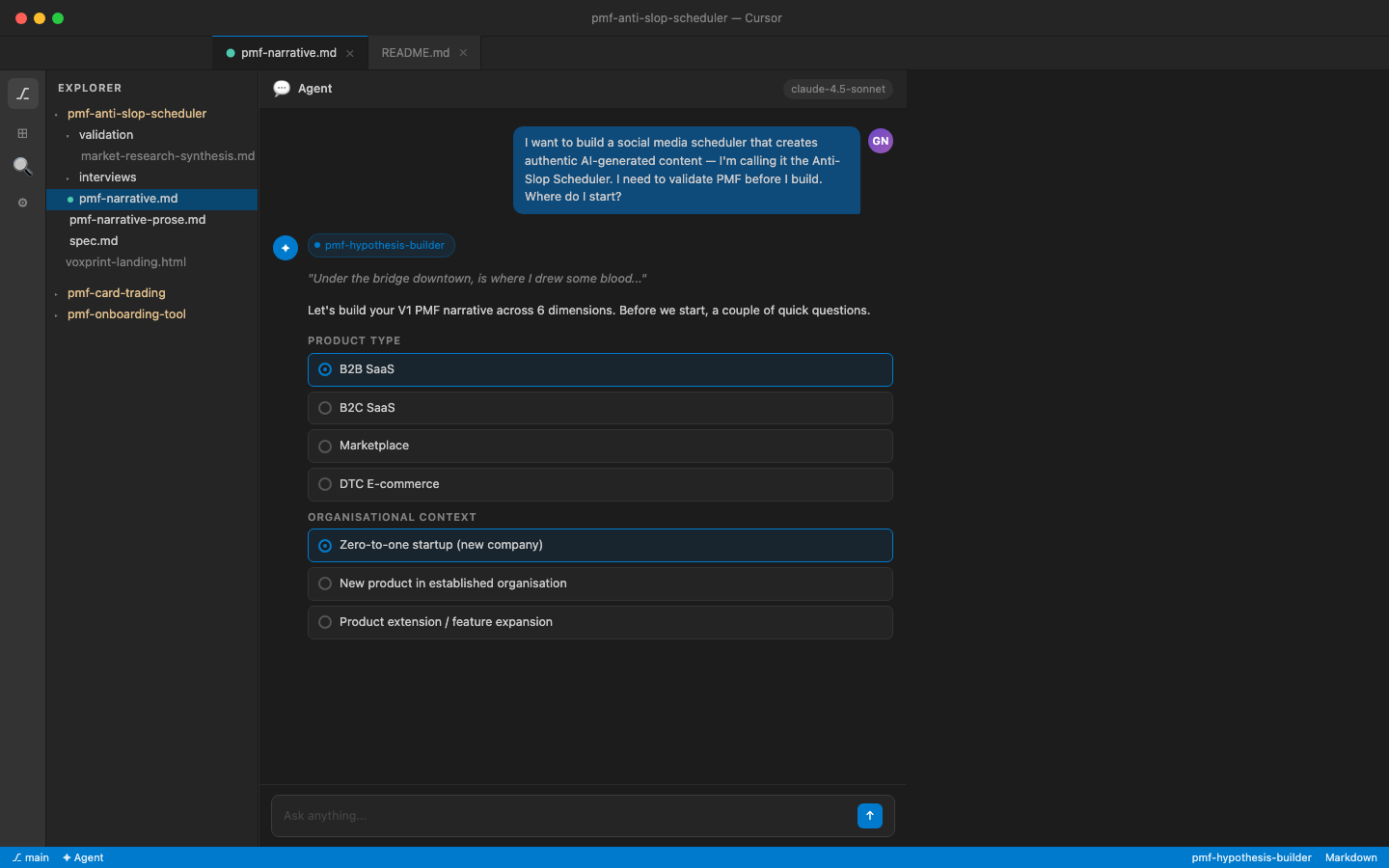
The pmf-hypothesis-builder skill walks you through each dimension with a set of questions.
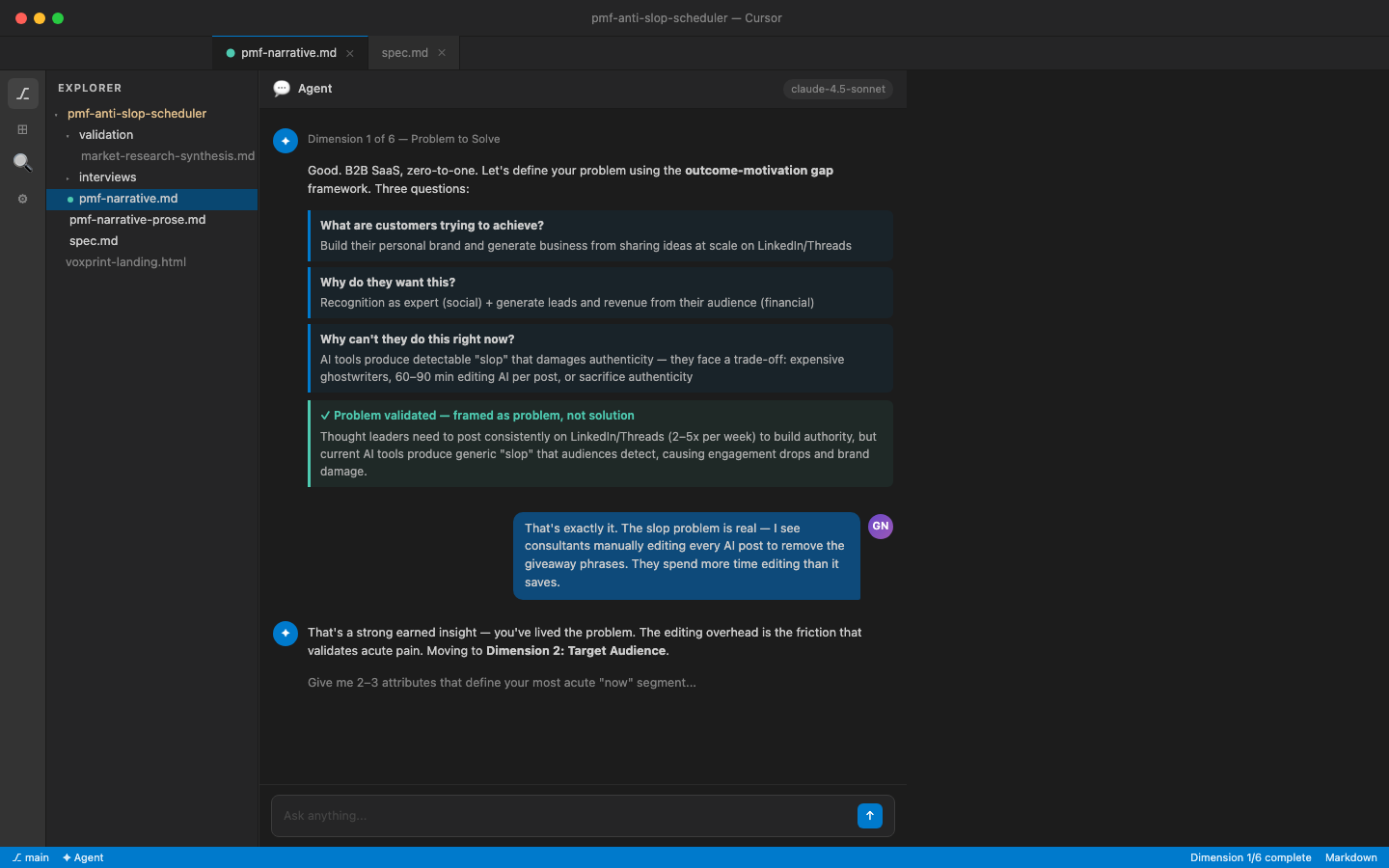
By the end you have a document: six dimensions written out, each with a confidence score (1-10) and a note on why you rated it that way. You also have to name your riskiest dimension, the one where, if you’re wrong, the whole thing fails.
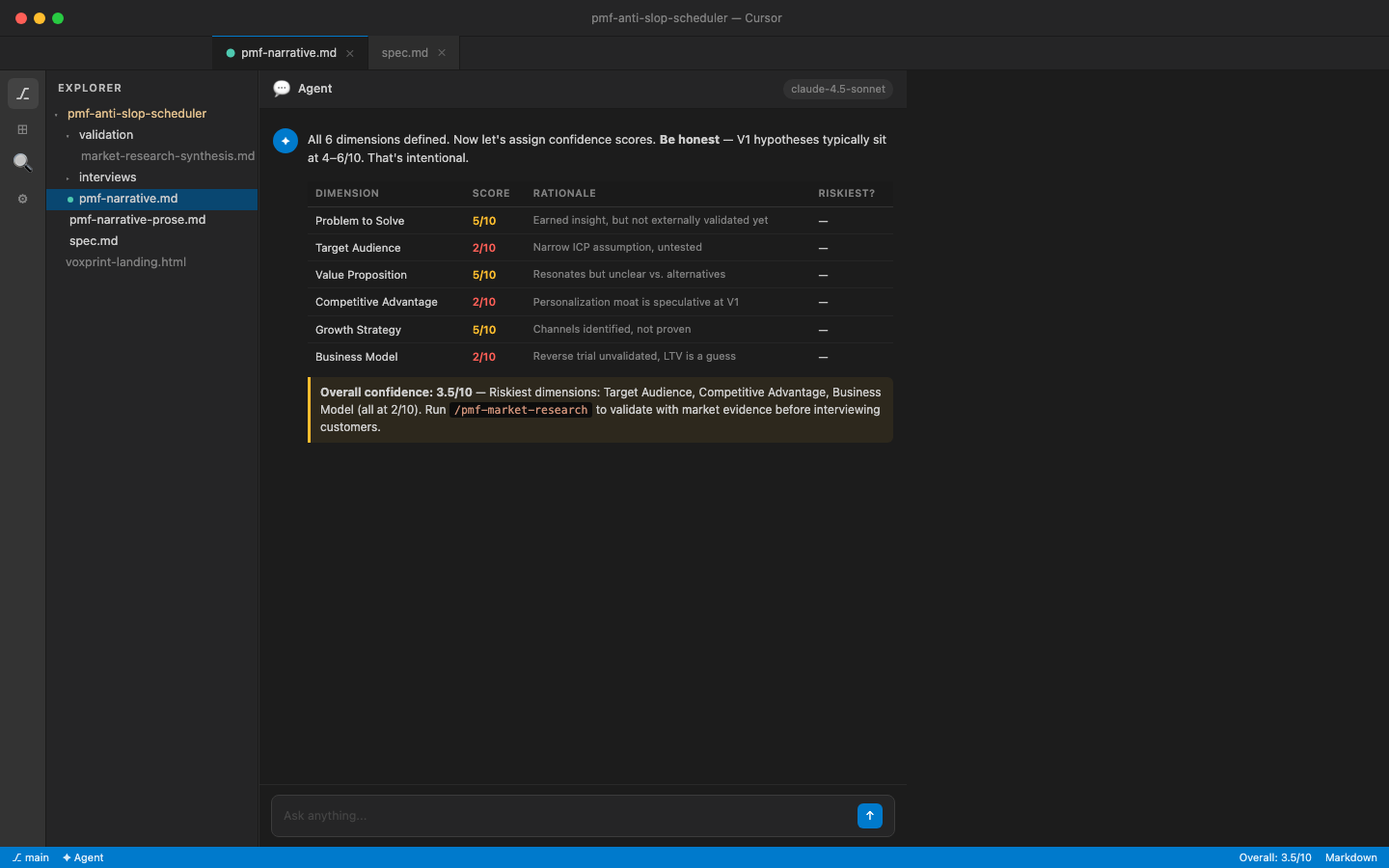
When I ran through this for something I’ve been building in the car rental space, I came out with an overall confidence of around 2/10 across the dimensions. A 2/10 at the start of the process tells you where to focus, not that the idea is dead. You want to find your weak spots before you’ve spent months on them.
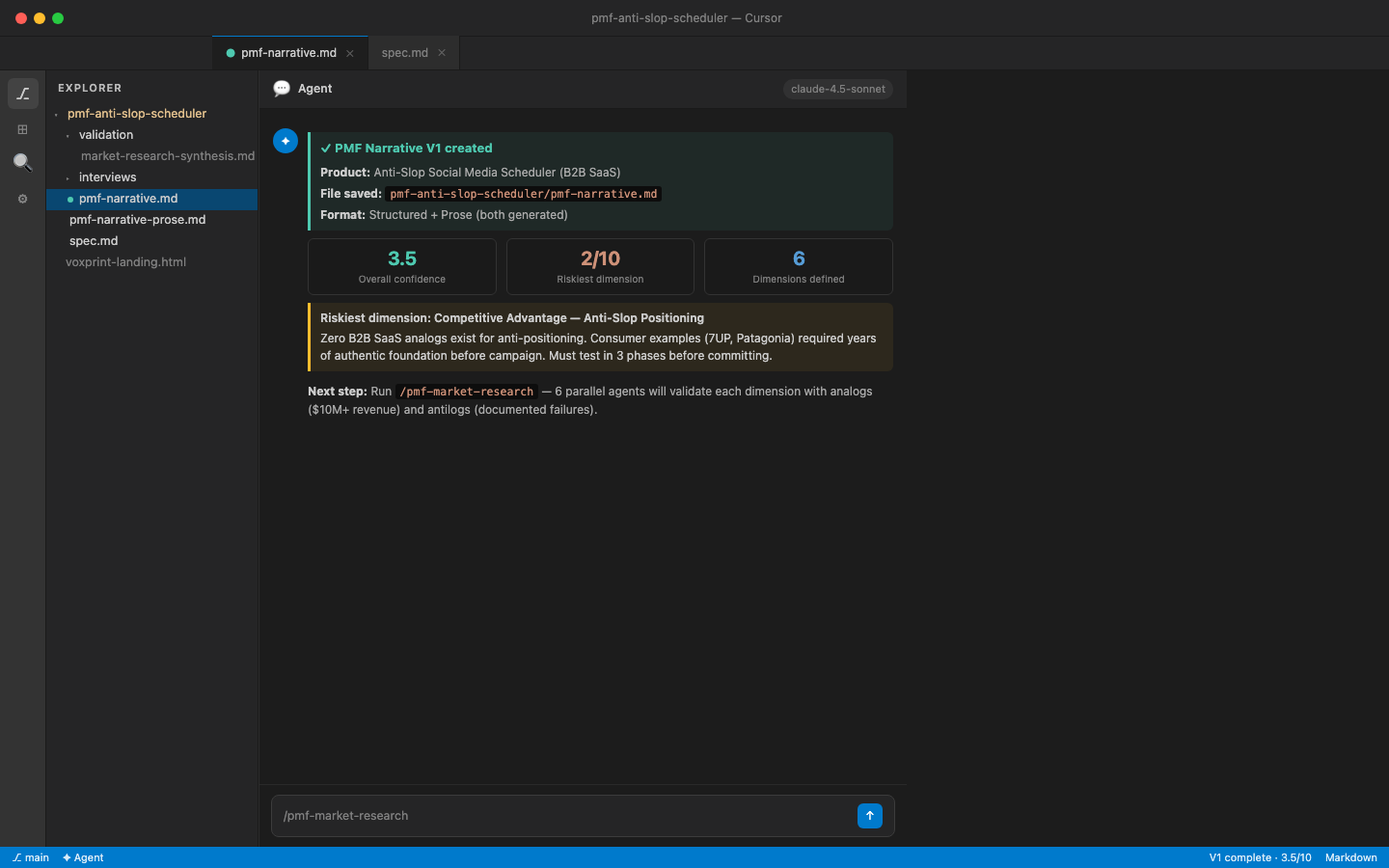
The second step: analogs and antilogs
The pmf-market-research skill runs parallel research on each of your six dimensions and produces a list of analogs (products that succeeded in a similar way) and antilogs (products that failed, and why).
Analogs tell you the path is possible; antilogs show you where everyone who tried it before ran into trouble.
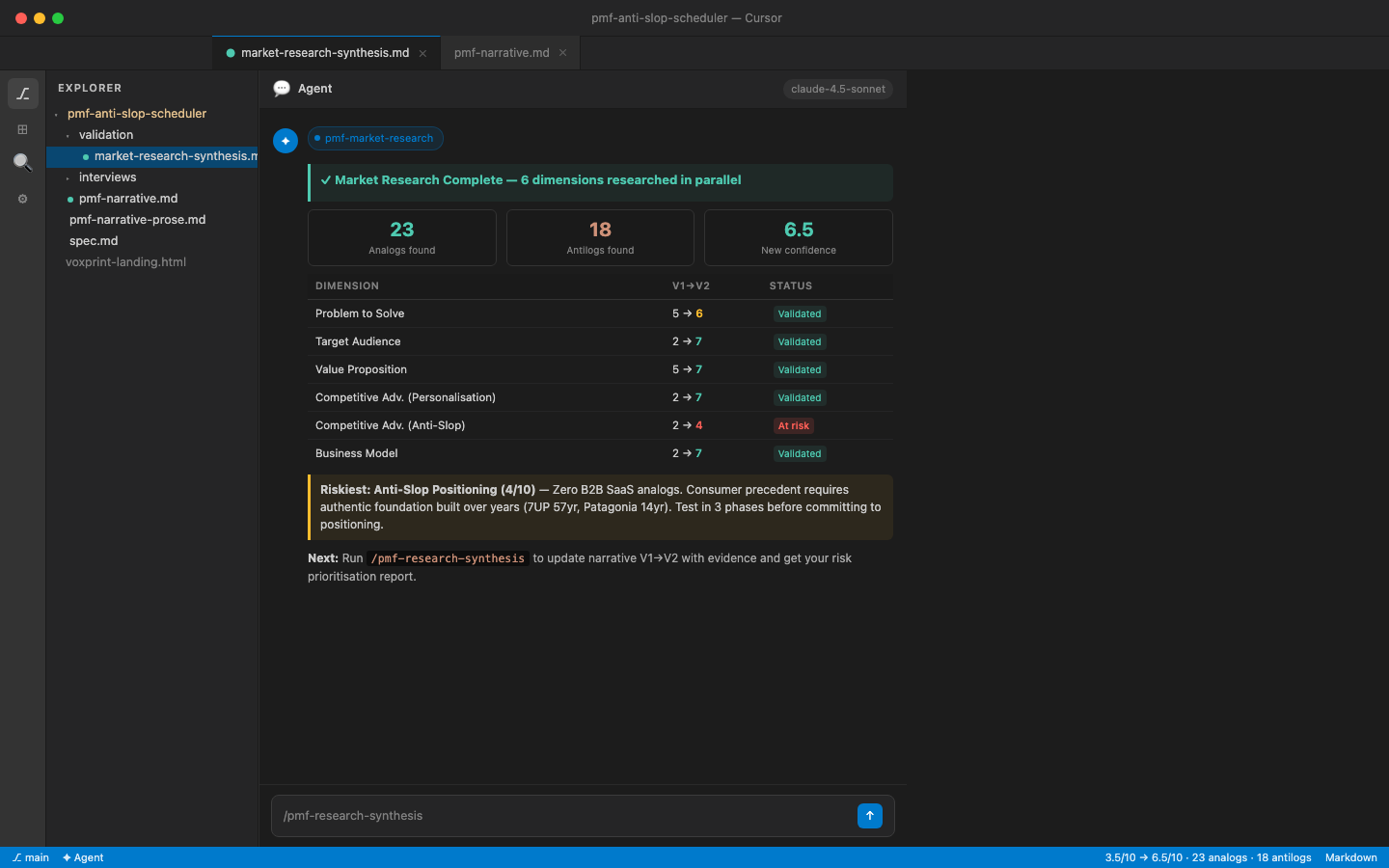
On the anti-slop scheduler product idea I was exploring earlier this year, market research found 23 analogs and 18 antilogs across the six dimensions. Some were reassuring: the personalization moat had strong precedent in consumer products (Netflix, Spotify, Notion). The anti-slop positioning was a different story, with zero B2B SaaS analogs to point to. Consumer brands had done it successfully after decades of authentic foundation. Nobody had done it as a cold positioning play.
What you get out of the research isn’t a verdict on the idea. One dimension gets flagged: this one needs phased testing before you commit to it. Try the messaging on a landing page first. See if it differentiates, or whether incumbents can copy it with one tweet.
When you don’t like what you find
The honest thing about running through analogs and antilogs is that sometimes what you find is that your idea is weaker than you thought: a lot of antilogs, gaps in your market knowledge, customer segments that turned out to be less “now” than you assumed. That’s uncomfortable, and it’s much better to find out at the research phase than six months into a build.
The third step: synthesis and what to do next
The pmf-research-synthesis skill takes the analog/antilog research and produces a risk score for each dimension, then recommends one of three paths: refine the narrative, pivot a dimension, or reset entirely.
There’s also a pmf-status check that gives you a quick read on where you are in the workflow and what to run next. It helps when you come back to a project after a few days and want to pick up where you left off.
The full sequence looks like this:
/pmf-hypothesis-builder: Write the V1 narrative with confidence scores
/pmf-market-research: Run analogs/antilogs across all six dimensions
/pmf-research-synthesis: Calculate risk scores, update narrative to V2
/pmf-status: Checkpoint: what’s the riskiest dimension now, what’s the next validation step?
The output is a V2 PMF narrative with updated confidence scores across all six dimensions and a prioritized list of assumptions to test before writing any code.
Get it for free on Github

I’ve packaged all four skills and released them on GitHub. They work in Claude Code or Cursor, same as any other skill. Just point at the URL and ask Claude Code or Cursor to install it. You can and should add it to the PM OS if you have it, but not required.
It’s free, no paywall.
If you run through the process on an idea and want to share what you found, I’d genuinely like to hear it. Reply to this email.
That’s all for today.
That’s all - hope this was helpful!
New AI Skills
I have tested these over multiple interactions and they work much better than generic stuff you see everywhere:
Transform todo lists and calendars into top 5 PM achievements
Create compelling executive decks from Quick Dirty Test analysis
As always, you can find them in my AI Skills Library for PMs (180+ AI skills for product work).
